Inside the B-17 Flying Fortress
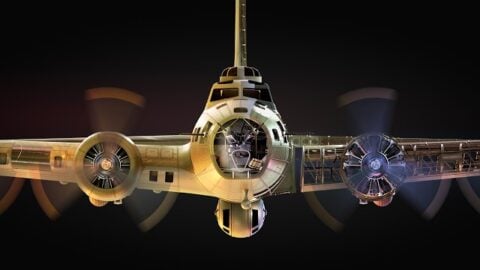
YouTube / Blue Paw Print
During the early years of World War II, the Boeing B-17 Flying Fortress emerged as the centerpiece of the United States’ strategic bombing campaign over Europe. Designed for high-altitude, long-range missions, the aircraft was capable of penetrating deep into enemy territory in broad daylight, relying not on speed or stealth, but on formation tactics and an unprecedented level of defensive firepower for survival.
Built for War: Design and Construction
The B-17 was engineered with durability in mind. Its rugged airframe, redundant systems, and four powerful radial engines allowed it to sustain heavy battle damage and still return home. The aircraft’s large wingspan enabled it to carry substantial bomb loads over long distances, making it ideal for sustained bombing operations against industrial and military targets far beyond the front lines.
True to its name, the Flying Fortress bristled with machine guns positioned throughout the aircraft. From the nose compartment to the dorsal turret and tail gunner’s station, nearly every angle of approach was covered. This network of defensive armament enabled the B-17 to fend off enemy fighters while maintaining formation, creating overlapping fields of fire that protected the bomber group as a whole.
The Men Inside the Machine
Operating the B-17 required a coordinated crew of ten, each assigned a critical role. Pilots managed the aircraft through hostile skies, while navigators plotted courses across unfamiliar terrain. Bombardiers controlled the Norden bombsight for precision strikes, and gunners defended the aircraft from attacking interceptors. Engineers monitored engine performance and assisted with defensive duties, ensuring the aircraft remained operational even under intense enemy fire.
Tactics That Made the Difference
The B-17’s effectiveness was not solely due to its construction. It was also a product of evolving combat tactics. Tight bomber formations allowed multiple aircraft to concentrate their defensive firepower, making it difficult for enemy fighters to approach without entering a lethal crossfire zone. This formation-based strategy transformed the bomber from a vulnerable target into a collective airborne fortress.
Over time, the B-17 became more than just a weapon of war- it evolved into a symbol of Allied resilience and determination. Its reputation for toughness, survivability, and combat effectiveness cemented its place in aviation history.