

This WWII Propeller Aircraft Survived Longer Than Most Jet Fighters
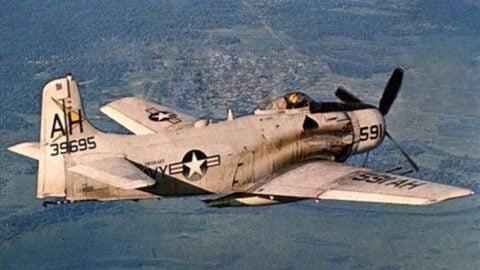
Photo by U.S. Navy, Public domain, via Wikimedia Commons
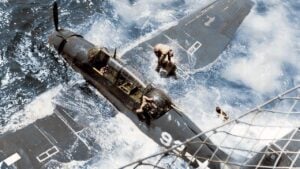
The Douglas A-1 Skyraider holds a rare place in aviation history. Designed during World War II, it continued to fight long after jet aircraft became the norm. Slow, loud, and heavy, it remained in front-line combat because it could do what faster aircraft often could not: stay over the battlefield and carry a massive load. Its long service life made it one of the most unusual survivors of the jet age.
On November 4, 1965, a Skyraider launched from the USS Midway carrying bombs, fuel tanks, and an unexpected item. Mounted under one wing was a porcelain toilet fitted with fins. The Navy marked a bombing milestone with a dark sense of humor. The mission became famous, but it reflected a deeper story about an aircraft that refused to fade away.
Origins at the End of World War II
The Skyraider began in 1944 when the U.S. Navy wanted a single-seat aircraft to replace dive and torpedo bombers. Douglas designer Ed Heinemann focused on range, payload, and simplicity. The result was a large propeller aircraft built around the Wright R-3350 engine, producing more than 2,000 horsepower.
Weight reduction shaped every decision. Engineers removed the internal bomb bay and mounted weapons on the wings. Systems were simplified, parts lightened, and even the tail wheel redesigned. By the time the prototype flew in March 1945, the aircraft carried up to 8,000 pounds of weapons and could fly more than 1,500 miles.
Entering Service in a Changing Era
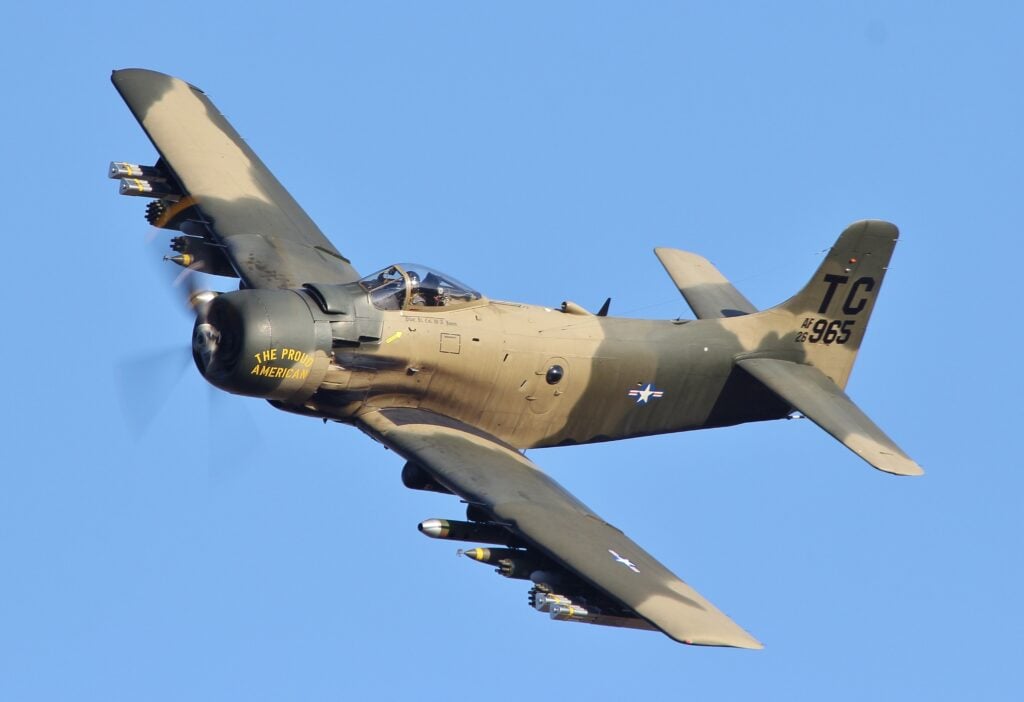
The war ended before the Skyraider saw combat, but production aircraft reached Navy units in 1946. Officially named the AD-1, it entered service just as jet aircraft appeared. Many assumed propeller planes would soon vanish from carrier decks.
Instead, the Skyraider found new uses. It could loiter for hours, fly slowly enough to spot targets, and strike with accuracy. The Navy tested it in radar, rescue, and support roles. Its real test came in 1950, when war broke out in Korea.
Proving Its Worth in Korea
Skyraiders flew their first combat missions from USS Valley Forge in July 1950. Jets were faster, but they lacked endurance and payload. The Skyraider could remain overhead while ground forces called for help.
Pilots praised its strength and control. The aircraft carried bombs, rockets, and even torpedoes. In 1951, Skyraiders breached the Hwachon Dam using naval torpedoes, the only such attack of the war. Losses were heavy, leading to added armor and improved pilot protection.
Evolution and Adaptation
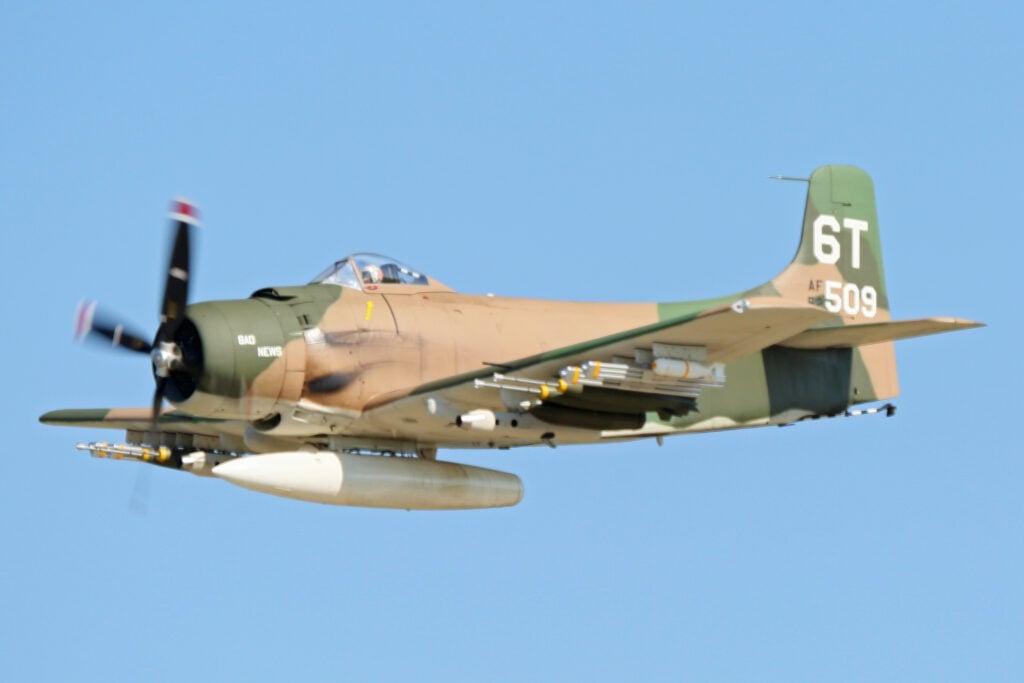
Throughout the Korean War, the design evolved. Later versions improved engines, landing gear, and handling. The AD-5 introduced a wider fuselage with side-by-side seating, allowing crew members to share tasks during night or radar missions.
These changes turned the Skyraider into a flexible platform. Some versions jammed radar signals, others guided strikes, and several performed search and rescue support. Its adaptability kept it relevant while newer aircraft came and went.
The Skyraider in Vietnam
By the early 1960s, many Navy jets had replaced older aircraft, but the Skyraider remained. Renamed the A-1, it flew the first strikes of the Vietnam conflict in 1964. Its greatest role became escorting rescue helicopters.
Known as “Sandy” missions, Skyraiders flew low and slow, drawing fire and attacking threats near downed pilots. In 1966, Major Bernard Fisher landed his damaged A-1 under fire to rescue another pilot, earning the Medal of Honor.

A Propeller Against Jet Fighters
Skyraiders even faced jet aircraft. In one encounter, A-1s shot down a MiG-17 during a rescue mission. The engagement showed that speed alone did not decide every fight, especially at low altitude.
The aircraft served with allied nations and continued flying into the final days of the Vietnam War. South Vietnamese pilots used it in desperate support missions until 1975. Commander Clarence Stoddard, who flew the famous toilet mission, was killed in action in 1966 after his aircraft was struck by missiles.
The Skyraider began as a World War II design, fought in Korea, and became a symbol of endurance in Vietnam, long after many early jets had disappeared from service.

_(7911148090).jpg)
.jpg)